Asphalt Driveway Maintenance Checklist for Hobbs, NM Homeowners
By Hobbs Paving · Asphalt paving, sealcoating & striping in Hobbs, NM
A well-built asphalt driveway is one of the better investments you can make in a Hobbs home, and it can easily last two decades or more — but only if you look after it. Out here in the Permian Basin, the sun, the wind and the wide temperature swings work on your pavement every single day. The good news is that keeping asphalt healthy is not complicated or expensive. It is mostly a handful of small, repeatable habits done at the right time of year. This checklist walks through exactly what a Hobbs homeowner should do, and when, to get the longest possible life out of a driveway.

Print it, save it, or just keep the rhythm in mind. None of these tasks take long on their own, and together they are the difference between a driveway that looks tired at year eight and one that still looks sharp at year twenty. We serve homeowners across Hobbs, Lovington, Eunice, Jal and the rest of Lea County, and the routine below is built specifically for our high-desert climate along US-62/180 and NM-18.
Keep it clean — the easiest habit of all
Cleaning sounds too simple to matter, but it is the foundation of every other maintenance step. Dirt and grit act like sandpaper underfoot and under tires, slowly wearing the surface. More importantly, anything sitting on your driveway is trapping heat, holding moisture, or attacking the binder that holds the asphalt together. In the constant Lea County wind, dust and sand pile up along edges and in low spots fast.
Give the driveway a good sweep or a blow-off every few weeks, and hose off the surface a couple of times a year to clear the fine grit that a broom leaves behind. Pull any weeds pushing up through edges or cracks right away — their roots pry the pavement apart and open a path for water. And deal with automotive fluids quickly. Oil, gas, transmission fluid and brake fluid all soften and dissolve asphalt binder, so blot fresh drips, scrub the spot with a degreaser and rinse. A driveway you keep clean simply ages more slowly than one you do not.
Watch for cracks and fill them early
Cracks are the single most important thing to stay ahead of, because a crack is an open door. Once water finds its way through the surface and down into the base, our temperature swings do the rest — the ground moves, the crack widens, and what was a hairline becomes a network. Add the weight of vehicles and you are on the road to a pothole. The whole game is stopping water before it gets under the pavement.
Walk your driveway a few times a year and look closely, especially after the summer heat and again before winter. Catch cracks while they are narrow and they are a quick, inexpensive fix. Small hairlines can sometimes be handled with a quality crack filler, but branching cracks, alligator-pattern areas, or anything wider than about a quarter inch is worth a professional look. Our crack filling service seals those channels properly so moisture stays out of the base, and if an area has already started to break apart, our asphalt repair crew can cut it out and patch it before it spreads. Either way, early is always cheaper and easier than late.
Sealcoat on a regular cycle
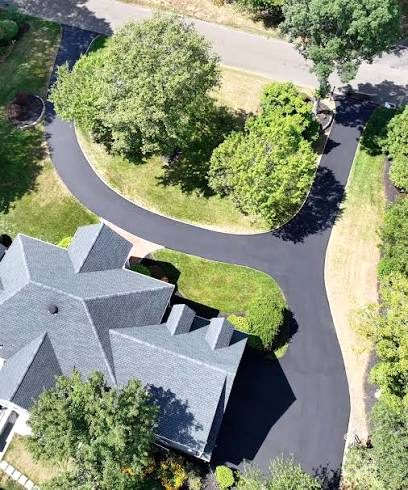
If cleaning is the foundation and crack filling is the emergency care, sealcoating is the routine that keeps everything else easy. A sealcoat is a protective layer applied over the asphalt that shields it from UV rays, oxidation, water and automotive chemicals. In the Hobbs climate, where the high-desert sun is relentless nearly year round, that UV protection matters more than it would almost anywhere else. Unprotected asphalt fades from black to gray, gets brittle, and starts to ravel and crack years earlier than it should.
For most Hobbs driveways, a fresh seal every two to three years is the right rhythm, though the real answer is to watch the surface. When the deep black has faded to gray and the texture feels dry and rough, the pavement is telling you the old protection has worn off. A new driveway should cure for roughly 60 to 90 days before its first seal, and after that the cycle keeps the surface flexible, dark and water-resistant. You can read more about how we approach it on our sealcoating service page, including how we schedule around the summer heat and monsoon storms so the coating cures properly.
Want a Pro to Take a Look?
Tell us about your driveway and we will let you know exactly what it needs — fast, friendly, local paving across Hobbs & Lea County.
Manage water and drainage
Water is asphalt's biggest enemy, so how it moves across and off your driveway matters. Even though Hobbs is dry for much of the year, the monsoon season brings sudden, heavy downpours, and a driveway that lets water pond is a driveway that will fail early. Standing water works its way into any weak point and stays there long enough to do damage, and repeated soaking of the base leads to soft spots and sinking.
After a good rain, take a walk and note where water pools instead of running off. A few puddles that dry quickly are normal; large areas that hold water for a long time point to a low spot or a drainage problem worth addressing. Keep the edges of the driveway clear so runoff has somewhere to go, and make sure landscaping, mulch or soil is not building up against the pavement and trapping moisture along the sides. If you have a spot that consistently holds water, mention it when you call — sometimes a small correction now prevents a much bigger repair later.
Protect the edges and go easy on heavy loads
The edges of a driveway are its most vulnerable part. Unlike the middle, the perimeter has no pavement beside it to brace against, so it cracks and crumbles first — especially when tires run off the side onto soft or unsupported ground. Try to keep vehicles centered rather than riding the very edge, and consider backfilling the sides with soil or gravel so the pavement has lateral support. Keeping grass and weeds trimmed back from the edge helps too, since roots love to work their way in there.
Weight is the other thing to watch. Residential driveways are built for cars, pickups and daily use — not for parking a loaded oilfield truck, a heavy RV, or a full construction dumpster for weeks at a time. Concentrated weight, particularly in the summer when asphalt is softer, can leave depressions and cause cracking. If a heavy delivery or a big vehicle is unavoidable, try to spread the load and limit how long it sits. For anything routinely heavy, a driveway can be built or reinforced for it — that is a design conversation worth having up front. Industry maintenance guidance from groups like the National Asphalt Pavement Association lines up with what we see across Lea County: the driveways that last are the ones whose owners handle the small stuff consistently and avoid abusing the surface.
Your season-by-season Hobbs maintenance rhythm
Put it all together and the year has a natural flow. In spring, do a thorough clean, inspect for any cracks that opened over winter, and get on the schedule if the driveway is due for a seal — spring and fall are the easiest windows for that work. Through summer, stay on top of oil drips and weeds, keep an eye on how the surface handles the heat, and watch the forecast so a fresh seal has a dry window to cure. In fall, inspect again and fill any new cracks before the cold arrives, so water is not sitting in open channels through the winter. And in winter, mostly just keep it clean and plan ahead — the cold is the time to book spring work, not to pave or seal.
That is the entire checklist: keep it clean, fill cracks early, sealcoat on a cycle, manage water, protect the edges, and respect the load. None of it is hard, and all of it adds years to your pavement. The homeowners who follow this routine are the ones still getting compliments on a smooth, black driveway long after their neighbors are calling about potholes. If you would rather have a professional handle the inspection and the work, that is exactly what we are here for.
Frequently asked questions
How do I maintain an asphalt driveway in the Hobbs heat?
Keep it clean, fill cracks as soon as they appear, and sealcoat every few years so the Permian Basin sun cannot dry out and oxidize the surface. Clear standing water and remove oil drips quickly, and address soft or sunken spots before they turn into potholes. Those few habits protect the driveway far longer than the effort they take.
How often should a Hobbs driveway be sealcoated?
For most driveways in and around Hobbs, sealcoating every two to three years is a good rhythm. The intense high-desert UV and heat here can dry asphalt out faster than in milder climates, so we look at the actual color and texture of your surface rather than the calendar alone. A gray, brittle-looking driveway is telling you it is time.