Parking Lot Restriping in Hobbs, NM: When to Redo It
By Hobbs Paving · Asphalt paving, sealcoating & striping in Hobbs, NM
Striping is the part of a parking lot that nobody notices until it stops working. Nobody walks into a business and thinks about how crisp the stall lines are. But people absolutely notice a lot where two cars end up sharing a space because the line between them disappeared, or where the arrow at the entrance is faint enough that somebody guesses wrong and comes in against traffic. Faded markings turn an orderly lot into a negotiation, and in a town where a lot of traffic arrives in full-size pickups and work trucks, that negotiation costs you spaces you already paid to build. This is a guide to reading your own lot in Hobbs, knowing when the paint is actually done rather than just aging, and understanding why our climate puts that date sooner than the manufacturer's literature suggests.
We stripe and restripe commercial lots, retail centers, medical offices, churches, apartment properties and industrial yards across Hobbs, Lovington, Eunice, Jal, Tatum and Monument, including the high-turnover properties along US-62/180 and NM-18 where the layout has to keep working while the crew is on site.
Why paint in the Permian Basin does not last as long
Traffic paint fails in two ways, and it is worth separating them because they have different cures. The first is abrasion, which is mechanical. Tires scuff pigment off the pavement, and the places where tires cross a line most often lose it first. The second is ultraviolet degradation, which is chemical. Sunlight breaks down the binder that holds the pigment to the asphalt, and once that binder is compromised the paint gives up its color and its grip on the surface without anything needing to drive over it at all.
Here, the second one is the bigger factor, and that is what surprises property managers who have run lots elsewhere. Hobbs gets a lot of clear sky, and a dark asphalt surface under that sky runs far hotter than the air temperature on the forecast. Paint applied to a surface that spends a large part of the summer that hot, in that much direct light, simply ages faster. A lot that would look acceptable for four years in a cooler, cloudier place can read tired here in half that time.
Wind adds a third factor that is specific to Lea County. Blowing sand is abrasive, and a fine grit layer sitting on the pavement works like a mild sandpaper every time a tire passes over it. It is also why sweeping matters more than people expect. A lot that gets swept is not just cleaner-looking, it is holding its markings longer.
The oilfield traffic piece compounds all of it. Heavy trucks put more weight through each contact patch, they turn tighter and more often than passenger vehicles, and stationary turning is exactly the motion that grinds paint off asphalt. On a lot that serves service companies or takes delivery trucks, the drive lane markings often need attention on a completely different schedule from the stalls.
How to tell your lot is actually due
The mistake is judging striping from the perspective you usually see it from, which is standing next to your own car, close up, at whatever time of day you happen to arrive. The perspective that matters is the one your customer has, which is from a vehicle, in motion, at an angle, deciding in about two seconds where to go.
So do the drive-in test. Come into your own lot the way a first-time visitor would, and pay attention to whether the layout answers your questions before you have to look for the answers. Can you tell where the lane is and where the stalls start? Is the direction of travel obvious? Do you know which way to go to reach the door, and where you are not allowed to stop?
Then walk it in the middle of the afternoon, when the sun is at its harshest and washes out weak contrast. Afternoon glare is the honest light for paint. Markings that look passable in soft morning light can vanish at two in the afternoon, and two in the afternoon is when half your traffic arrives.
Specific things worth looking for while you are out there. Stall lines that have gone from a solid band to a dotted, patchy trace, which means the paint is thin enough that the next season will finish it. Directional arrows and stop bars that are legible only if you already know what they say. Fire lane markings and no-parking hatching that have faded to the point where people park in them, which they will, because nobody argues with a line they cannot see. Accessible stall markings and access aisle hatching in any state of doubt at all, since that is the one part of a lot where faded is not a cosmetic issue. Wheel stops and curbs that have lost their contrast paint. And numbered or reserved stalls in an apartment property, where a faded number reliably becomes a complaint at the office.
If most of the lot reads fine and only the entrance, the main drive lane, or the stalls nearest the door are worn, you do not necessarily need the whole lot done at once. Restriping the high-wear zones and leaving the rest for the next cycle is a legitimate approach, as long as somebody is tracking it so the whole lot does not drift into a patchwork of three different vintages of paint.
Lines Getting Hard to Read?
We will walk your lot, tell you whether it needs a full restripe or just the high-wear zones, and lay it out so it works — Hobbs & Lea County.
Restriping is the moment to fix the layout
This is the part most people skip, and it is the part with the most value in it. When a lot gets restriped, the existing layout is usually just traced. The crew follows the ghost lines, everything lands where it was, and any problem that was built into the original layout gets renewed along with the paint. But the old lines are only a record of what somebody decided once, possibly decades ago, possibly for a different tenant with a different business.
So before we put paint down, it is worth asking whether the layout is the right one. A few things are commonly worth changing. Stall width is the big one in this part of the country. A layout drawn for sedans does not serve a customer base arriving in crew-cab pickups, and stalls that are technically legal but functionally tight produce door dings, cars parked over lines and drivers who circle rather than park. Sometimes losing a couple of stalls to widen the rest gives you a lot that actually holds more vehicles in practice.
Traffic flow is the next one. If you consistently see vehicles cutting diagonally across the lot, backing into the drive lane, or meeting nose to nose in an aisle, the layout is fighting the way people naturally move through your property. Angled stalls with one-way aisles solve a surprising number of those problems, and the decision costs nothing extra at restriping time because the paint is going down either way.
Then there is everything that has changed since the last layout. A new dumpster enclosure that trucks cannot reach without a wider approach. A delivery door that now takes semis. Curbside pickup spaces that the business started offering and never marked. Electric vehicle spaces. A loading zone that needs to stop being a de facto employee parking row. Crosswalk bars connecting the far row to the entrance, which matter more than people think on a lot where pedestrians and trucks share space.
And accessible parking, which is its own subject and not one to guess at. Space counts, van-accessible stalls, access aisle widths and signage are governed by rules, not by preference, and a restripe is the natural moment to bring a lot into line if it has drifted. We wrote a separate guide on ADA parking lot striping requirements that covers what those rules actually require. For the general standards behind pavement markings, the Federal Highway Administration's Manual on Uniform Traffic Control Devices is the reference that traffic markings trace back to.
Sealcoat first, or stripe only?
Order of operations decides whether you waste money, so this question is worth answering before anything gets scheduled.
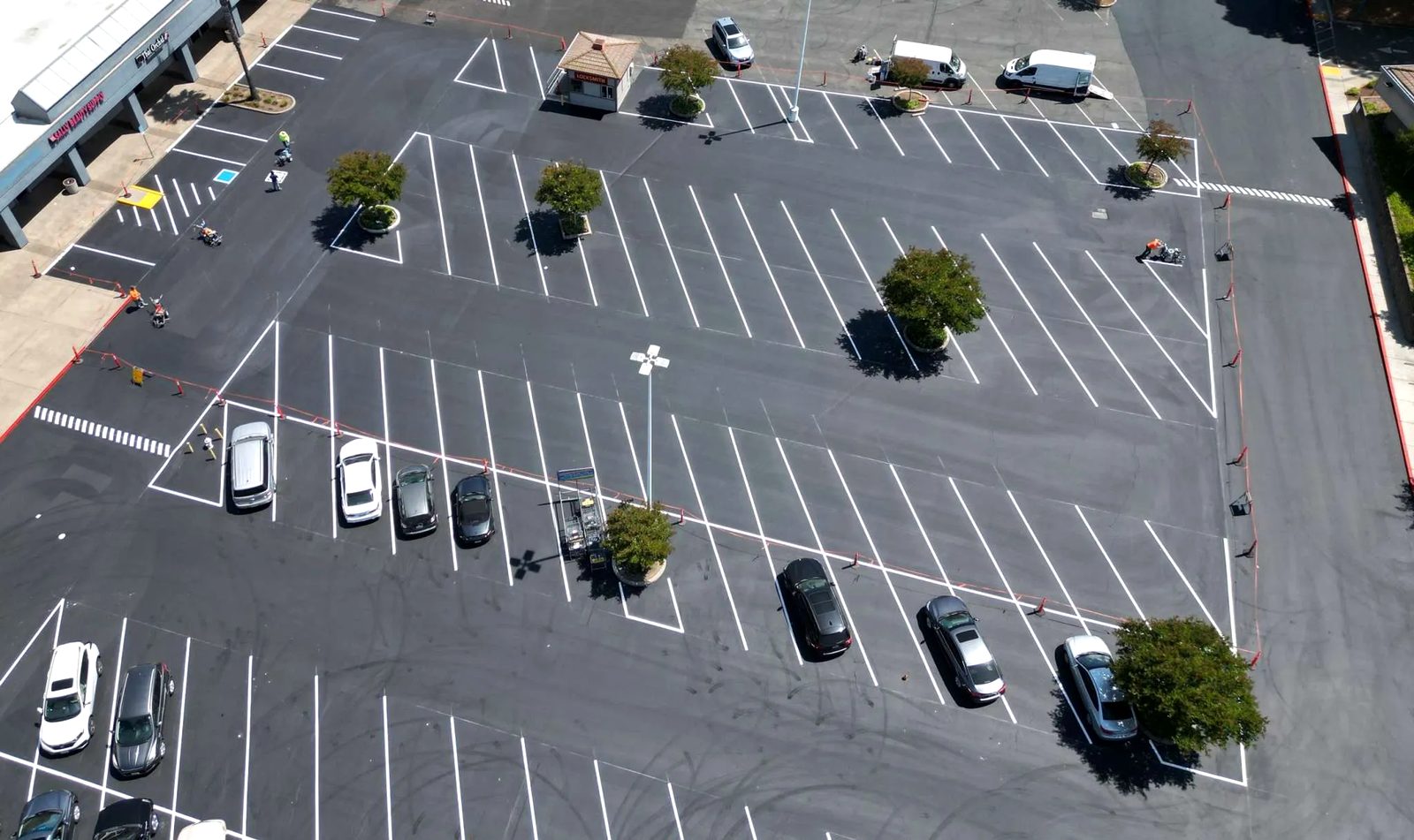
If the lot is due for sealcoating, seal first. Sealer covers everything on the surface, so any paint applied beforehand is money spent on markings that are about to disappear. Sealing first also produces the better-looking result by a wide margin, because bright white and yellow on fresh black sealer has contrast that the same paint on gray, oxidized asphalt cannot match. That contrast is not only aesthetic. It is legibility, which is the whole point.
The timing between the two steps matters. Paint needs cured sealer underneath it, and striping too early is a dependable way to get markings that peel off in sheets within a season. Our sealcoating page covers the cure side of that, and how our heat and monsoon humidity change the window.
If the surface is sound and not due for sealer, then striping on its own is the right call, and it is the easier job by far in terms of disruption. A striping-only visit needs the lot empty in sections for a matter of hours rather than a day or more.
Repairs come before both. Crack filling, patching and any milling or resurfacing should be finished before paint goes down, because there is no point laying a stall line across a section that is going to be cut out in the spring. If your lot needs that kind of work, our line striping service gets sequenced after it rather than before, and we will tell you that up front rather than taking the easy booking.
What a striping day looks like
Striping needs three things: a clean surface, a dry surface, and no vehicles. Everything about how we schedule it comes from those three.
The surface gets blown and swept first. Paint does not bond to dust, and in Lea County there is always dust. Skipping this step is the single most common reason striping fails early on a lot that otherwise looks fine.
Then the layout gets set. On a restripe with a good existing layout, that means measuring and snapping from the surviving lines so the new paint lands straight rather than following a drifting ghost. On a new or changed layout it means laying the whole thing out from the building face and the property lines, which takes longer and is the part that determines whether the finished lot looks professional or improvised.
Paint goes down with a striping machine for the long runs, and by hand for stencils, arrows, accessible symbols, hatching and curb work. Drying is fast in our climate, often a matter of well under an hour for foot traffic, though we keep vehicles off longer than that and we cone off finished sections so nobody drives across a line before it has set.
On a lot that cannot close, we phase it. Half the lot, or a section at a time, with cones and signage moving through the property so there is always somewhere to park and always a route to the door. Timing helps more than anything here. Early mornings, or a Saturday for an office property, or the slow stretch of the week for retail. We would rather come in at seven on a Saturday and be gone before your traffic builds than do it midweek and cost you customers.
Weather is simpler than it is for sealcoating but not irrelevant. Paint needs a dry surface and dry air, wind is a factor for spray overshoot, and a monsoon cell that rolls in on fresh paint will streak it. We watch the forecast and move a date rather than gamble on it.
If your lot in Hobbs or anywhere in Lea County is getting hard to read, call us. We will walk it with you, tell you honestly whether it needs everything or just the entrance and the drive lane, flag anything about the layout worth changing while the paint is off, and schedule it around your traffic rather than ours.
Frequently asked questions
How often does a parking lot in Hobbs, NM need to be restriped?
Most commercial lots in Hobbs need fresh striping every year or two, and that is a shorter interval than the same lot would need in a milder climate. The reason is the sun. Ultraviolet light breaks down the binder in traffic paint, and the Permian Basin delivers more of it, at a higher surface temperature, than almost anywhere paint manufacturers use for their general guidance. Traffic is the other variable, and it is not distributed evenly across a lot. Drive lanes, entrances and the aisles closest to the door lose their markings well before the stalls at the back of the property, so a lot can look acceptable from the street and still have worn-out arrows and faded crosswalk bars where people actually need to read them. The practical test is not the calendar. Stand at your entrance in the middle of the afternoon, when the sun is flattest on the pavement, and see whether you can read the layout at a glance. If a stall line is a suggestion rather than a line, if an arrow takes a second to interpret, or if an accessible stall no longer reads clearly as accessible, the lot is due. We would rather look at it and tell you it has another season in it than have you guess.
Should I sealcoat before restriping, or can I just repaint the lines?
If the lot is due for sealcoating anyway, seal first and stripe after, because sealer covers every marking on the surface and any paint you put down beforehand is wasted. That sequence also gives you the best-looking result, since fresh white and yellow on fresh black sealer has far more contrast than paint applied over gray, oxidized asphalt. Timing matters in between: paint needs the sealer to be properly cured before it goes down, and striping a lot too soon after sealing is a reliable way to get markings that peel within a season. If the surface is in good condition and not due for sealer, restriping on its own is perfectly reasonable and is the cheaper path in terms of downtime, since a striping-only job usually takes a fraction of the access that a full seal and stripe does. The order matters in one more case worth mentioning. If the lot needs crack filling, patching or milling, that work comes before both, because there is no sense laying paint across a section that is going to be cut out and replaced in a few months.