Sealcoating Day in Hobbs, NM: What to Expect
By Hobbs Paving · Asphalt paving, sealcoating & striping in Hobbs, NM
Most of the questions we get about sealcoating are not about whether to do it. People understand that a sealed surface holds up better than a bare one. The questions are about the day itself: how long am I losing my driveway, what do I have to move, can my customers still park, and when can I drive on it again without ruining it. Those are fair questions, and the answers in Hobbs are a little different from the generic answers you will find written for somewhere with mild summers and no wind. Permian Basin heat, Lea County wind and monsoon moisture all change the timing. Here is what a sealcoating job actually looks like on a property in Hobbs, from the week before to the week after.
We sealcoat driveways, commercial lots, apartment properties, church lots and office parking across Hobbs, Lovington, Eunice, Jal, Tatum and Monument, including properties on the busy corridors off US-62/180 and NM-18 where access has to keep working while the job runs.
What sealcoating is doing, and what it is not
Worth being clear on this first, because it shapes every other decision on the day. Sealcoat is a thin protective layer applied over sound asphalt. It shields the binder that holds your pavement together from ultraviolet light and oxidation, it keeps water and automotive fluids from soaking into the surface, and it restores the dark, uniform look that makes a lot read as maintained rather than neglected. In our climate, where the sun is intense and the surface temperature of a lot in July runs far hotter than the air, that ultraviolet protection is the part that earns its keep.
What sealcoat is not is a repair. It does not add structural strength, it does not bridge cracks, and it does not fix a surface that is already crumbling. Spread over alligator cracking or a failing base it will look good for about a month and then split along every line underneath it. That is why the first thing we do is not schedule a sealcoating date, it is walk the property and decide whether sealcoating is the right spend at all. On a surface with real distress, the honest answer is repairs first, or resurfacing, and sealer later.
The other thing sealcoat does not do is replace the underlying maintenance schedule. Cracks still need filling before they are sealed over, drainage still has to work, and a lot that ponds water is going to keep failing in that spot no matter how fresh the sealer looks. Our sealcoating page covers the service in detail, but the timing and logistics below are what most people actually want to know once they have decided to do it.
The week before: scheduling around Permian Basin weather
Sealer cures by releasing water into the air. That single fact drives the whole calendar. It needs a dry surface going down, dry air while it cures, and no rain for a stretch afterward. In Hobbs that makes spring and fall the comfortable windows and the monsoon months the ones that require watching the forecast closely.
We look at three things when we set a date. Rain is the obvious one, and we need a clear window well past the application itself, because sealer that gets rained on while it is still curing will streak, wash or lift, and there is no fixing that except doing it again. Overnight low temperature matters more than people think, since the surface has to stay warm enough through the night for the cure to keep progressing. And wind, which Lea County supplies generously, affects both the spray pattern and the edges, so a day with steady thirty mile per hour gusts is a day we would rather squeegee than spray, or move entirely.
Heat is a factor, but not the one people expect. A very hot surface can cause the top of the sealer to skin over before the layer underneath has released its water, which leaves a film that looks dry and is not. That is why summer work here gets scheduled early in the morning, and why we sometimes prefer a mild October day to a blazing July one even though the July surface feels like it should cure faster.
If a monsoon cell puts your date at risk, we would rather call you and move it than gamble. A rescheduled sealcoat is an inconvenience. A rained-out sealcoat is a redo.
What you need to do before we arrive
Preparation on your side is short but it matters. Everything on the asphalt has to come off it: cars, trucks, trailers, dumpsters, boats, basketball hoops, potted plants along the edge. Park them somewhere they will not need to cross the work area, not just somewhere off the pavement.
Turn off sprinklers and drip irrigation anywhere near the pavement, and leave them off until we say it is clear. This is the single most common cause of a blemish on an otherwise perfect job. A sprinkler head that cycles at four in the morning onto sealer laid the previous afternoon leaves a pale washed patch that stays visible.
Cut back grass and weeds that have grown over the edges of the asphalt. Vegetation hanging over the pavement makes a clean edge impossible, and the difference between a job with crisp edges and one with ragged ones is usually decided before we ever open a pail.
Point out oil, transmission fluid and hydraulic stains rather than hiding them. Sealer does not bond to contaminated asphalt, and untreated spots come back through the new surface as ghost marks within weeks. Those areas get scrubbed and primed, but only if we know where they are.
For a commercial property, the planning piece is access. Decide where customers and deliveries go, put a sign on the door a couple of days ahead, and tell your staff which entrance stays open. If the lot is too big or too busy to close at once, we split it into zones and do it in phases, the same way we approach resurfacing.
Ready to Get Your Lot or Driveway Sealed?
We will walk the property, tell you honestly whether it needs sealing or repairs first, and schedule around the weather — Hobbs & Lea County.
Sealcoating day, hour by hour
We start early. On a Hobbs summer day that means arriving not long after sunrise, both to get ahead of the surface temperature and to get ahead of the wind, which tends to build through the afternoon.
The first hour or two is cleaning, and it is the part that determines how well the sealer sticks. The surface gets blown clear, edges get cut where dirt and grass have crept in, and anything embedded gets swept or scraped. Sealer bonds to asphalt, not to the dust sitting on asphalt, so a lot that looks clean from a distance still needs this step. Oil spots get degreased and primed at this stage too.
Next comes the repair work that was agreed in advance. Cracks get filled, small holes get patched, and those areas get time to set before anything goes over them. This is where a job can stretch longer than a homeowner expects, and it is time well spent, because sealer laid over an unfilled crack is just a thin dark film over a gap that is still open.
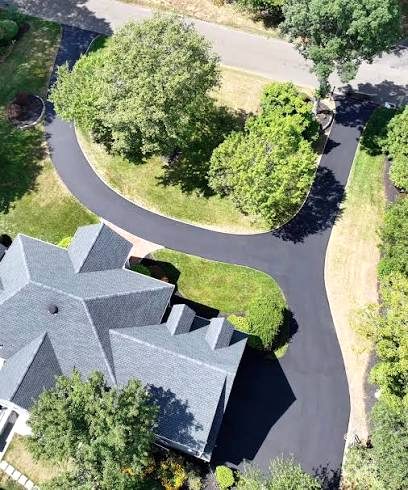
Then the sealer goes down. On driveways and smaller lots we often squeegee or brush the first coat, which works the material into the surface texture and gives better adhesion than spraying alone. Larger lots are usually sprayed for uniformity and speed. Edges, curb lines and areas around buildings get cut in by hand regardless of what the open field gets, because that is where a sloppy job announces itself.
Whether you get one coat or two depends on the surface. A driveway in decent shape being maintained on schedule is often fine with one. A lot that has gone a long time without sealer, or one carrying heavy traffic, generally gets two, with the second going on after the first has set enough to walk. Two coats means a longer day and a longer cure window, and we tell you which you are getting before we start rather than after.
Then the barricades and tape go up, and that is the part that actually protects your investment overnight.
Curing: when you can walk, drive and park again
Here is where the Hobbs answer diverges from the internet answer. The general rule is foot traffic after several hours and vehicles the next day, and that rule holds here most of the time. But the local conditions push it in both directions, and knowing which direction matters.
High heat does not shorten the cure. It can skin the top of the layer while moisture is still underneath, which is exactly the condition that produces tire marks when someone drives on a surface that felt dry to the touch. Conversely, a mild, dry, breezy fall day can cure a surface faster than a scorching one, because the air is actually carrying the moisture away.
Humidity from a monsoon pattern slows everything down. Air that is already carrying moisture is not eager to take on more, so a humid August evening can add real time to the window. Two coats extends it further, since the second coat starts its clock later.
The distinction that saves the most grief is between driving and parking. A vehicle rolling across a nearly cured surface is brief contact and rarely leaves a mark. A vehicle parked in one place on a warm afternoon transmits weight and heat through four small contact patches for hours, and that is what leaves scuffs and prints. Power steering turns while stationary are the other classic culprit, which is why we tell people to roll while they turn for the first week or so.
Give it that first week of reasonable care and the surface hardens into something you can stop thinking about. The National Asphalt Pavement Association publishes general background on asphalt surface maintenance and preservation if you want to read further on why protecting the binder extends pavement life.
After the sealer cures: striping, cracks and the next cycle
If your property has parking stalls, fire lanes, accessible spaces or directional arrows, the layout is gone the moment the sealer goes down, and restriping is part of the job rather than an afterthought. Paint goes on after the sealer has cured properly, and applying it early is a good way to get striping that peels. On a commercial lot this is also the natural moment to correct anything that was wrong with the old layout, whether that is faded accessible stall markings, stalls that were laid out tighter than they should be, or a fire lane that drifted over the years. Our line striping service handles the layout side of this.
Once the lot is sealed and striped, protecting it is mostly about water and cracks. New cracks will appear eventually, because asphalt moves with temperature and our temperature swings are wide. Filling them the season they appear is cheap and effective. Letting them run through a monsoon means water reaching the base, and water in the base is how a good lot becomes a lot with potholes.
Keep drainage working. If runoff ponds somewhere it did not used to, something changed, and finding out what is more useful than sealing over it again next time. Sweep debris off the surface, especially fine sand and grit, which acts like an abrasive under tires. And keep an eye on the areas that take the most abuse, usually entrances, drive lanes and wherever trucks turn, since those will lose their seal earlier than the open field.
As for the next cycle, driveways and lots in this climate generally need sealer more often than the same surfaces would in a milder place, because the sun here is doing more work. The right interval depends on traffic, sun exposure and how the surface is holding, which is why we would rather look at your pavement than quote you a fixed number of years.
If you are thinking about sealcoating a driveway or a commercial lot in Hobbs or anywhere in Lea County, call us and we will come look at it, tell you whether it is ready for sealer or needs repairs first, and give you a realistic picture of what the day will cost you in access.
Frequently asked questions
How long do I have to stay off a freshly sealcoated driveway in Hobbs?
Foot traffic is usually fine within a few hours, and vehicles generally go back on after the surface has had a full day of dry weather. That is the short answer, and in Hobbs it comes with two local caveats. The first is that our heat does not speed the process up the way people assume. Sealer cures by losing water to the air, not by baking, so a surface that is hot on top can still be soft underneath, and a hot lot in July can hold a tacky layer longer than a mild lot in October. The second is that driving on it and parking on it are different things. Rolling traffic crossing a nearly cured surface rarely does damage. A vehicle parked in one spot on a warm afternoon puts steady pressure and heat through four contact patches for hours, and that is what leaves tire marks and scuffs. So the practical guidance we give is to keep everything off for the rest of the day, walk on it after several hours if you need to, drive on it the next day, and if you can leave a vehicle parked elsewhere for one extra day in the middle of summer, do it. We tell you the actual window for your property before we leave, because it depends on the weather that day and how many coats went down.
Do I need to do anything to prepare before the crew arrives?
Yes, and it makes a real difference to how the finished surface looks. Move every vehicle, trailer, dumpster and piece of equipment off the asphalt before the start time, and move them far enough that they are not going to be in the way of the crew working the edges. Shut off any sprinklers or drip lines that throw water onto the pavement, and leave them off until we tell you it is clear, because a sprinkler cycling overnight onto fresh sealer will leave a permanent pale patch. Trim back grass and weeds growing over the edge of the asphalt, since anything hanging over the pavement is an edge we cannot cut cleanly. If you have oil or transmission fluid stains, point them out rather than covering them up, because those spots need a primer before sealer will stick to them. For a business, decide in advance where customers and deliveries will go, get a note on the door a couple of days ahead, and let staff know which entrance stays open. Fifteen minutes of preparation on your end usually saves an hour of ours and shows up in the finished edges.